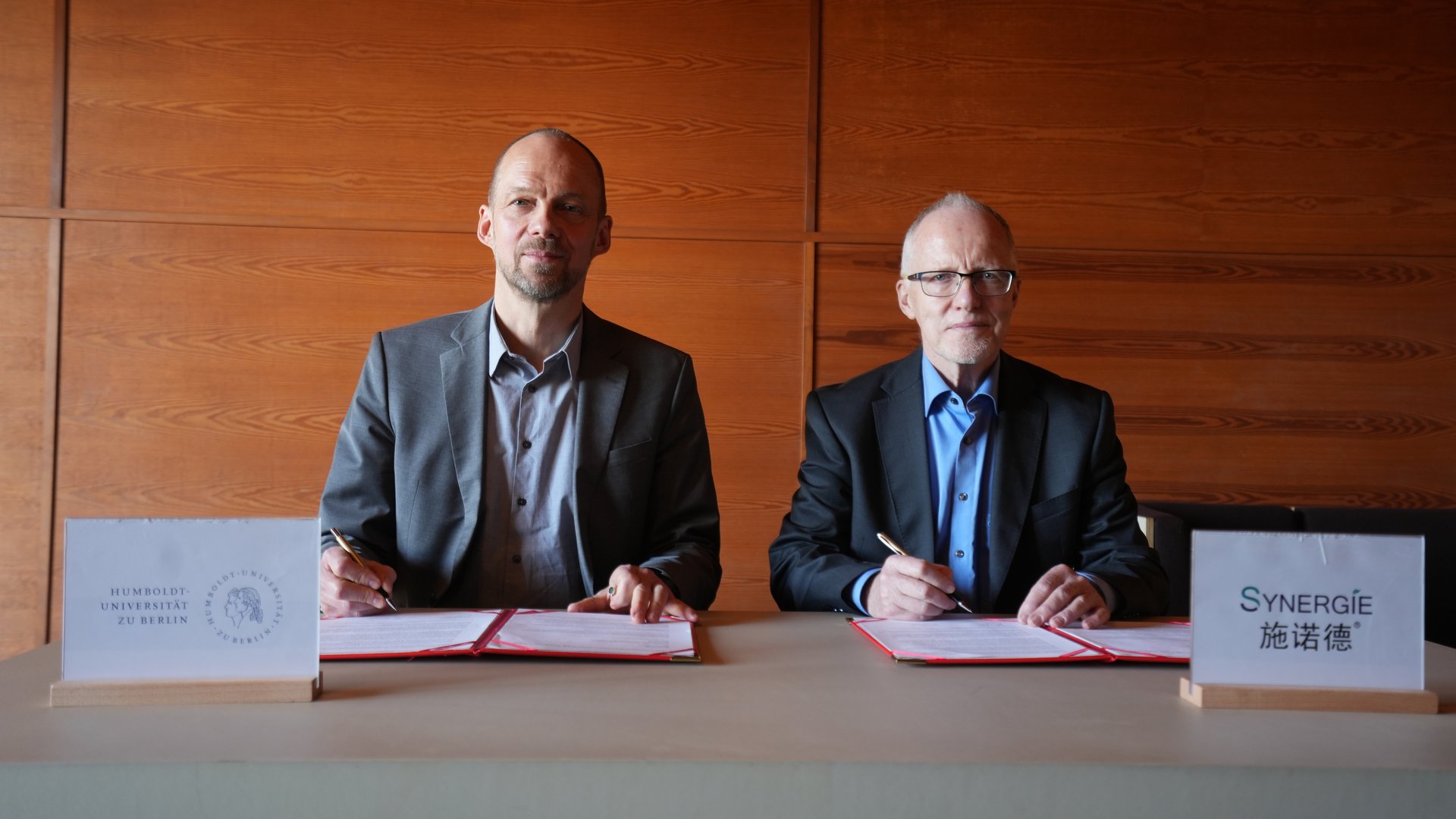
BERLIN, March 20 — Synergie Research Institute (Synergie GmbH) marked a milestone in its global strategic layout by renewing a strategic partnership agreement with China's agricultural leader Kingenta Group, and officially signing a crop application experiment partnership agreement with Humboldt University of Berlin (Humboldt-Universität zu Berlin). The implementation of these two heavyweight partnerships marks a key step forward for German technology in international agricultural innovation and industry-university collaboration.

Deepening International Cooperation: Building a global network for enhancement technologies
At 11:00 AM, at the Einstein House by Lake Schwielowsee, Synergie Research Institute first signed with Humboldt University of Berlin. Under the agreement, both parties will focus on high-efficiency N+P utilization, biostimulant innovation, and digital fertilization modeling, conducting systematic experiments around Synergie Solutions' application efficacy in major grain and cash crops. As a top German agricultural research institution, Humboldt University of Berlin will provide scientific data verification via its world-leading agroecological laboratories and field trial systems.
Subsequently, Synergie Research Institute and Kingenta Group officially signed the renewal document of the strategic cooperation agreement, marking a new stage of cooperation in the field of nutrient enhancer technology research, development, and promotion. Since the first signing in 2022, Kingenta has fully applied Synergie's nutrient enhancer technology to its products, promoting quality and efficiency improvement in the Chinese fertilizer industry. Mr. Li Yuxiao, Chairman of Kingenta Group, said: 'Kingenta always practices the concept of "joint development". This cooperation is not only a milestone for German technology exchange but also a pragmatic action in response to global food security challenges. We look forward to combining the "precise release control" of slow-release fertilizers with the "ecological enhancement" of Synergie's solutions through technical integration, providing farmers with more efficient solutions.'
Closed-door Seminar: Promoting green agricultural development through technology
After the signing ceremony, representatives of the three parties conducted in-depth exchanges and discussions on the latest research results, application prospects, and challenges faced by ecological enhancement technologies. Everyone agreed that strengthening international cooperation and exchange is the key to promoting green agricultural development, and all parties should work together to promote the innovation and application of ecological enhancement technologies.

Experimental Field Validation: Enhancement technology achievements highly recognized by third parties
Following the ceremony, representatives inspected three core experimental fields jointly run by Synergie Research Institute and Humboldt University of Berlin. On-site comparative trials showed that treatment groups using Synergie Nutrient Enhancement technology achieved a 12%-18% yield increase compared to conventional practices, with nitrogen utilization increased by approx. 25%. Dr. Georg Ebert emphasized: "Technological innovation must be closely combined with field practice, and experimental fields are the core venue to validate this logic."
'These two heavyweight collaborations are not only a milestone for the implementation of enhancement technologies, but also build a transnational closed loop of "basic research - technology development - industrial application."' — Dr. Georg Ebert, CEO of the Synergie Research Institute
Outlook: Building a global cooperative ecosystem
Dr. Georg Ebert pointed out in his closing remarks: 'These two heavyweight collaborations are not only a milestone for the implementation of enhancement technologies but also build a transnational closed loop of "basic research - technology development - industrial application." In the future, the Synergie Research Institute will rely on Kingenta Group's market resources in China and the research network of Humboldt University of Berlin to promote the localized adaptation of enhancement technologies in 30 major agricultural countries around the world.'
Industry analysis suggests that through the integration of Germany's cutting-edge R&D capabilities, China's industrialization strength, and the cutting-edge exploration of academic institutions, these two collaborations are expected to provide a replicable dual model of 'technology + business model' for global sustainable agricultural development, helping to accelerate the realization of the agricultural emission reduction targets of the Paris Agreement.